The Stick and the Rope: Moving Past Violence in the Age of the Unreal Engine
Note: The following contains spoilers for the ending of NieR: Automata and the basic gameplay mechanics of Death Stranding.
About two and a half years and change ago, in February 2017, a game called NieR: Automata dropped. The sequel to 2010’s Nier, it merged writer/director Yoko Taro’s idiosyncratic pacifistic vision with PlatinumGames’ unparalleled excellence in the storied field of extremely insane shit that blows up with spectacular aplomb. Together, they made a game about the cognitive dissonance that results from wanting nothing but peace when all you’re good at is war. The combat is in service of the narrative, rather than the traditional vice versa: the highly-customizable difficulty level acts as a tension knob rather than an aptitude grade, providing just the right amount of frustration and tension to provoke emotional responses — protectiveness, anger, hatred, contrition. Competitiveness is bred out of every gameplay system; the trophies are all purchasable with in-game currency, and a series of Dark Souls-esque server-side systems invoke a sense of community with other people undergoing the same trials, as each body you leave behind contains a message for other players. In the end, the game’s about the iterative process of improvement as the cycle of life, and it’s a theme that echoes from the core gameplay loop to the broad plot synopsis. Even as you mow down wave after wave of faceless stubby robots, the game inculcates a sense of community.
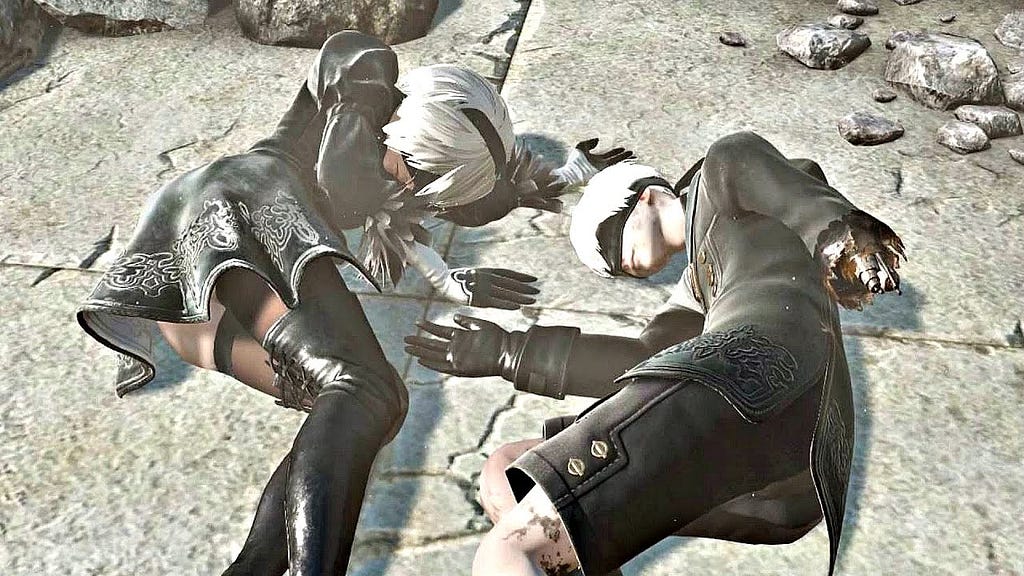
This all comes to an astounding head with the game’s finale, where, after an emotionally brutal duel between the game’s two main protagonists, the player is finally presented with the opportunity to defeat the true villain, the nefarious puppetmasters who engineered the conflict in the first place: Square Enix and PlatinumGames. The final challenge is the credits sequence, a brutal bullet-hell shooter where you have to essentially obliterate the game’s entire creative team, buoyed by words of encouragement left by other players, and just as things seem truly impossible and insurmountable, you get a shield of invincibility provided by a group of randomly selected other players, carrying you through to victory over the demons of authorial intent. After this physically and emotionally grueling experience, the game provides you with a choice: on one hand, you can sacrifice all of your save data — watching as the game methodically goes through each menu and UX element, deleting each record of your accomplishments— for the opportunity to pay it forward and help another player make it through that final conflict. On the other hand, you can keep your save data, but live knowing that you passed up an opportunity to contribute back to the system that carried you.
It’s an astounding, grand experiment, and an experience that’s stuck with me and moved me in a way few works of art do. Art, at its essence, is a function that takes in time and effort and produces empathy; videogames have the potential to maximize that function’s efficiency and effectiveness like few other media. The combination of immersion and player identification can produce astounding results when it comes to making a point, although that potential is difficult to realize in the big-budget, AAA space. Automata, for my money, was, until recently, the most successful attempt at walking this high wire; while it only reached the fullness of its vision in those final moments, with the entire game readying you into a state where you’re willing to accept the lessons of that finale, it asked an essential question about where videogames, and their relationship with violence, can go from here.
With Death Stranding, writer/director Hideo Kojima and his team begin to provide the outlines of an answer. Kojima’s primary creative output prior to this is the Metal Gear series, a sprawling eight-game time-jumping epic about history, legacy and po-faced sincerity that once famously asked, with an endearingly dorky straight face, if love can bloom even on a battlefield. As a series, it always felt like it was struggling in public with the dissonance between its gameplay and message, the conflict between Kojima’s desire to tell stories about the human condition and publisher Konami’s desire to sell millions of copies of a military espionage game. It was an anti-war polemic that fetishized the military, a story about our common humanity that asked you to treat people as rows on a spreadsheet. It never felt quite comfortable in its own skin, a neverending compromise between art and commerce, and following its twisting, turning path for twenty years was an experience as frustrating as it was rewarding. Metal Gear games were always light-years ahead of the pack, but they always felt light-years behind what they truly wanted to be.
Following his very public and acrimonious expulsion from Konami, Kojima was handed a dump truck full of money from Sony Interactive Entertainment with a simple remit: sell a fuckload of PlayStations and make our hardware look cool as shit. Kojima’s taken full advantage of that blank check to produce a truly astounding work that seeks to answer the question Automata laid out: how does the videogame medium progress and create tense, rewarding narrative experiences while eschewing violence? It draws inspiration from Kobo Abe’s short story “Nawa,” quoting from it in its very opening screen:
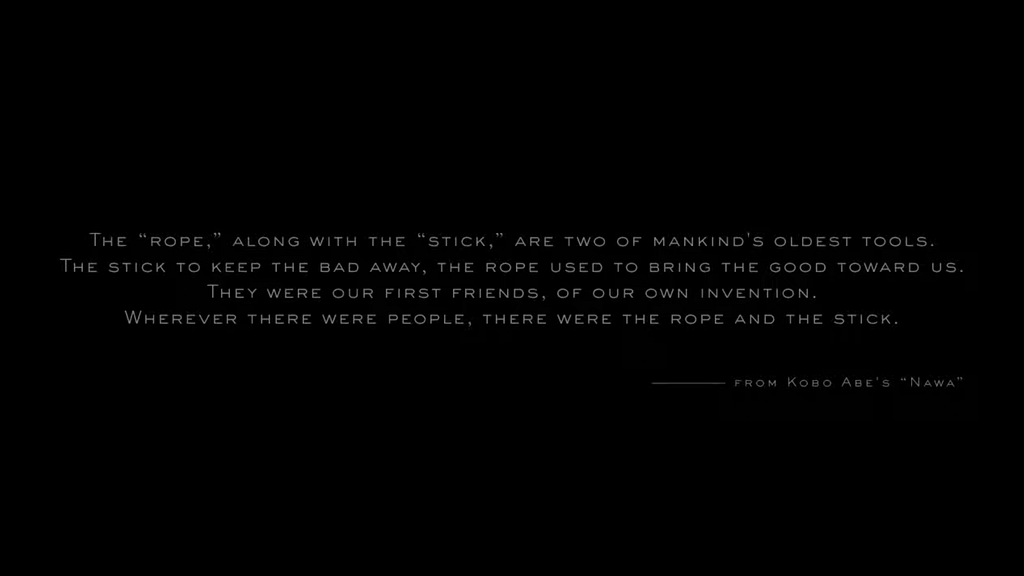
AAA videogames, up until now, have almost entirely relied on the stick. The universal interface between the player and the world is always a weapon: usually a gun, sometimes a sword, on special occasion a cursor used to move around units that carry guns and/or swords, the history of videogames is that of necessary, unavoidable conflict, where the tool through which you interact with the world is an item through which you do harm. Sometimes you shoot people to protect, sometimes you shoot people to destroy, but at the end of the day you’re always just shooting people, piling up dead bodies and incrementing integers in the game’s memory heap until the engine can’t render the unsightly vestiges of violence anymore, and so they disappear into the digital soil, out of sight and out of mind, somewhere past the draw distance.
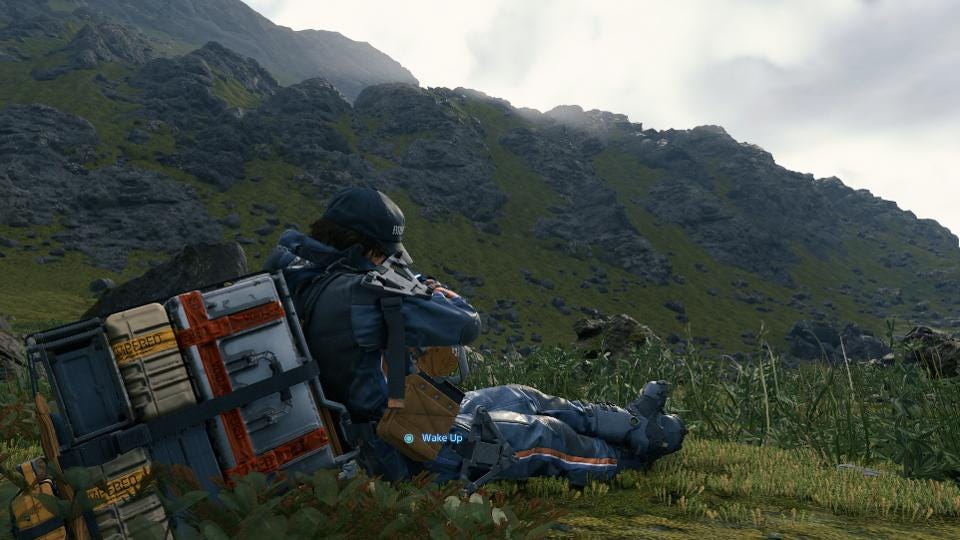
Death Stranding, on the other hand, tries something new. It’s a game about building rather than tearing down, and about connecting rather than severing. There’s a lot of discourse around the fact that it’s basically a game about being a FedEx dude who goes on hikes, and while that’s true in the reductionist sense, the core gameplay loop is really about building: it’s an infrastructure and logistics simulation, where you cooperate with other players in a form of asynchronous multiplayer to build a network of structures — safe houses, ziplines, garages, roads, bridges — to facilitate deliveries and connect urban centers. It’s about putting something somewhere not just because you need it, but because you know it might be helpful to others, too; about finding a sheltered area on a clear day and marking it for other players in the event of rain. It incentivizes this with a Facebook-esque system of Likes whereby players give each other kudos for their creations, but ultimately it’s a gameplay loop and system built around making you think of others and be part of a community, to blaze trails and leave signs and help each other out. It’s about your pulse pounding because you’re trying to deliver life-saving medication to a remote area and the feeling of relief when you’re low on battery and a kind stranger has already built a generator in the middle of the wilderness, and the desire to pay that forward. Even when you’re on your own personal journey, you always feel connected with others in a common purpose. It’s about attempting to reframe the language of virtual conflict from man vs. man to man vs. nature, and building a community to help others in that conflict. There’s violence and gunplay, yes — especially in three utterly stunning sequences I won’t spoil, but you’ll know them when you get there — but they’re used sparingly and effectively, in a way that seems like Kojima publicly wrestling with his legacy in the medium and making an earnest attempt to try to exorcise that demon and find a way forward.
Death Stranding is not a perfect game. It can, at times, feel more like work than play, although I’d argue that the requirement for a game to be “fun” to be worthwhile is an anachronism unique to videogames that’s entirely worth shedding. It has a singularity of vision that resonates fractally throughout every element, both ludic and narrative, that can be described generously as Pynchon-esque or pessimistically as childish and handholding. But it tries, wholeheartedly, to create a new language in the big-budget videogame space with which the player can communicate with the world. It’s an iteration on Automata in every way that matters: while the former provided encouraging messages and a single chance to sacrifice at the end for the sake of a sense of community, Death Stranding is entirely built around that concept. The endless sea of consumable world map collectibles from the Ubisoft model transforms into an interconnected network of your creations and those of others forming a cross-continental infrastructure to bring people together, not just the fictional inhabitants of the United Cities of America but you and your fellow players.
The game incentivizes cooperation in a number of ways — through the Like system, through narrative reinforcement, through the simple joy of easing the pain and suffering of others — but it always keeps its eyes on the prize: the idea that all we’ve got is each other, each other is all we’ve got, and the greatest satisfaction in life is in coming together to overcome adversity. That affirmation and accomplishment can be found while rejecting mindless competition, and that conflict need not require a zero-sum game. It’s a beautiful, affirming experience, and I’m excited to see the ripple effects it’ll create in the industry as developers are inevitably influenced by its themes and concepts and iterate on them. There’s a feeling, playing Death Stranding, of truly being on the ground floor of something new and beautiful and essential. I can’t wait to see what’s next.
- yoko-taro
- nier-automata
- death-stranding
- gaming
- hideo-kojima